
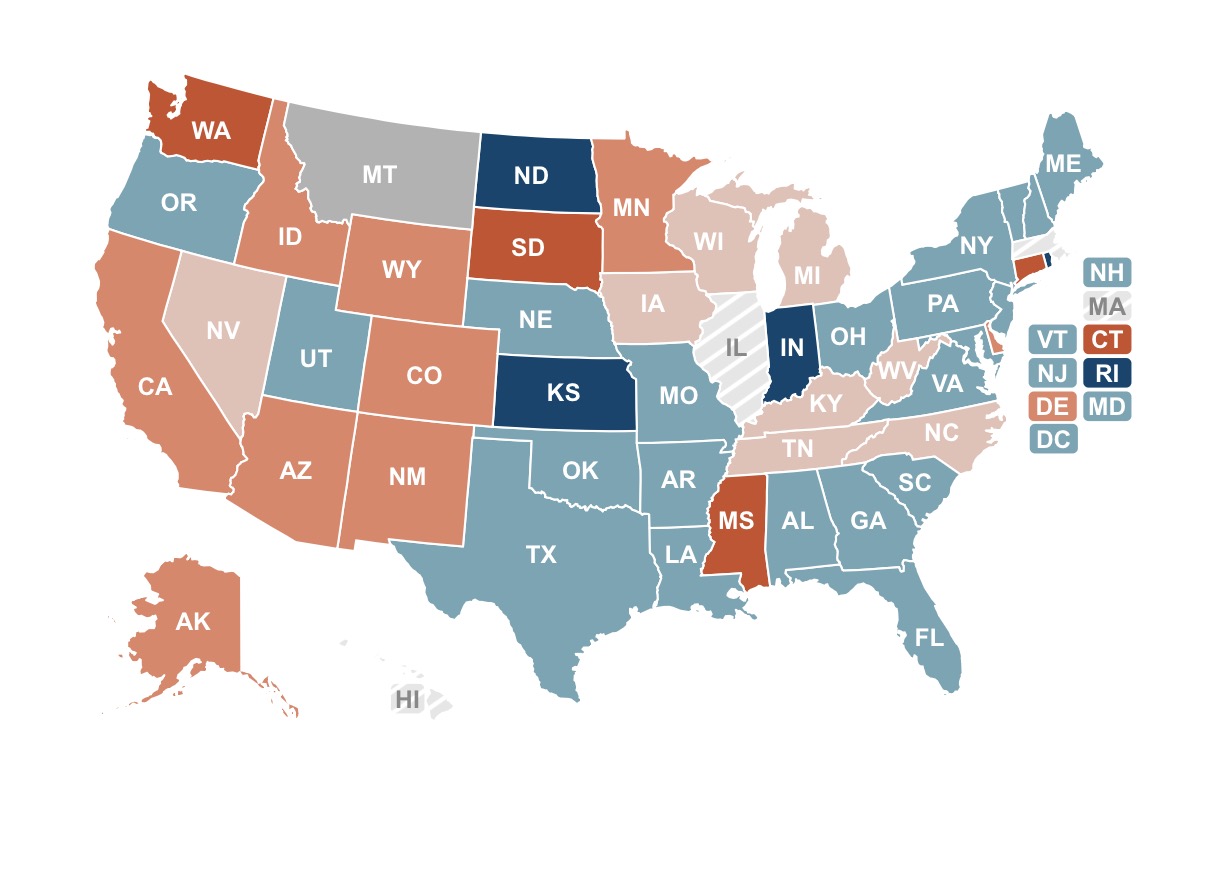
WASHINGTON, D.C. – October 26, 2026 – Half of the nation’s states have officially gone phone-free for the entire school day or “bell-to-bell"— a major milestone in the nationwide push to reduce distractions, strengthen relationships, and improve well-being at school, according to the organizations behind the Phone-Free Schools State Report Card.
With the passage of Pennsylvania’s S.B. 1014, 25 states have received an “A” or “B” grade on the report card, which offers the first comprehensive assessment of how every statute or executive order measures up against the evidence-based gold standard Phone-Free Schools Model Bill. The project was created by a coalition of leading child safety and well-being organizations, including The TAG Movement, Smartphone Free Childhood US, the Institute for Families and Technology, and Becca Schmill Foundation.
“Twenty-five states have now committed to giving students a phone-free school day, bell to bell. Thanks to the efforts of parent-advocates and lawmakers, these states are now supporting kids’ educational success and ability to pay attention, along with their mental health,” said Jonathan Haidt, author, The Anxious Generation & cofounder, The TAG Movement. “Phone free schools are simply better schools. Pennsylvania becoming the 25th state brings us to a tipping point, encouraging the rest of the states to go phone free bell-to-bell.”
“Reaching 25 states sends a clear message: Policymakers across the country recognize that students learn, connect, and thrive when phones are out of the picture,” said Deb Schmill, founder of the Becca Schmill Foundation. “From Pennsylvania to Utah, bell-to-bell policies are giving students back their attention—and giving schools back the opportunity to teach.”
“From stronger student well-being to higher teacher satisfaction, communities are reclaiming their classrooms,” said Kim Whitman, co-founder of Smartphone Free Childhood US. “Bell-to-bell policies help ensure students can focus on learning rather than the pressures of social media during the school day.”
“Thanks to the tireless work of parent advocates and legislators, students in half of our states now have phone-free schools. We know this increases child well-being and is welcomed by teachers,” said John Cusey, executive director for the Institute for Families and Technology. “We celebrate this accomplishment and look forward to the remaining states adopting this important policy as soon as possible.”
Under the report card’s criteria, an “A” grade is awarded to states requiring phones are stored in inaccessible locations from bell-to-bell. “B” grades are awarded to states with bell-to-bell policies without inaccessible storage requirements. Research shows that bell-to-bell phone-free schools policies can improve academic performance, support students’ mental and physical health, increase teacher satisfaction, strengthen student safety and privacy, and foster more connected school communities.
States with laws banning phone use during class time only are awarded a “C” grade and states with laws requiring districts adopt policies without mandated elements are awarded “D” grades, as they create unequal benefits statewide. Grades are updated as new laws or executive orders are signed.
Learn more about the Phone-Free Schools State Report Card.
###
About the Phone-Free Schools State Report Card
Launched in 2026, the Phone-Free Schools State Report Card is published by leading child safety and well-being organizations, including The TAG Movement, Smartphone Free Childhood US, Institute for Families and Technology, and Becca Schmill Foundation. The report evaluates whether the laws in all 50 states and Washington, D.C., meet the gold standard for phone-free schools: policies requiring all students to store their personal electronic devices in secure, inaccessible locations for the entire school day (bell-to-bell).